
Stop Using Your Client’s Photos to Promote Your Social Media Business
And Why This Problem Is Getting Worse
There’s a shift happening in the equine industry right now.
Actually — there are several shifts happening at once.
More businesses are realizing they need a presence online.
More trainers, breeders, and brands are investing in content.
And alongside that, there’s been a rapid rise in people offering social media management services.
On the surface, that sounds like growth.
But underneath it, there’s a problem that keeps showing up — over and over again.
Social media managers using their client’s images to promote their own business.
And not just social media managers.
Sale companies are doing it too.
And in many cases, neither group fully understands that they don’t actually have the right to do that.
Where This Expands Beyond Social Media Managers
This issue doesn’t stop at Instagram managers building portfolios.
It shows up in sale companies as well.
A horse is consigned.
Images are provided — sometimes by the owner, sometimes by the trainer.
And those images get used to:
-
promote the horse (which is often within scope, depending on the license)
-
promote the sale
-
promote future consignments
-
promote the sale company itself
That last part is where things often cross the line.
Because now the image is no longer being used solely to market the horse.
It’s being used to market the company running the sale.
And unless that usage was licensed?
It falls into the same category:
Using someone else’s work to promote your own business.
The Part That Keeps Getting Skipped
Photography is not just “content.”
It is intellectual property.
That means every image has:
-
an owner
-
a set of rights attached to it
-
and specific permissions for how it can be used
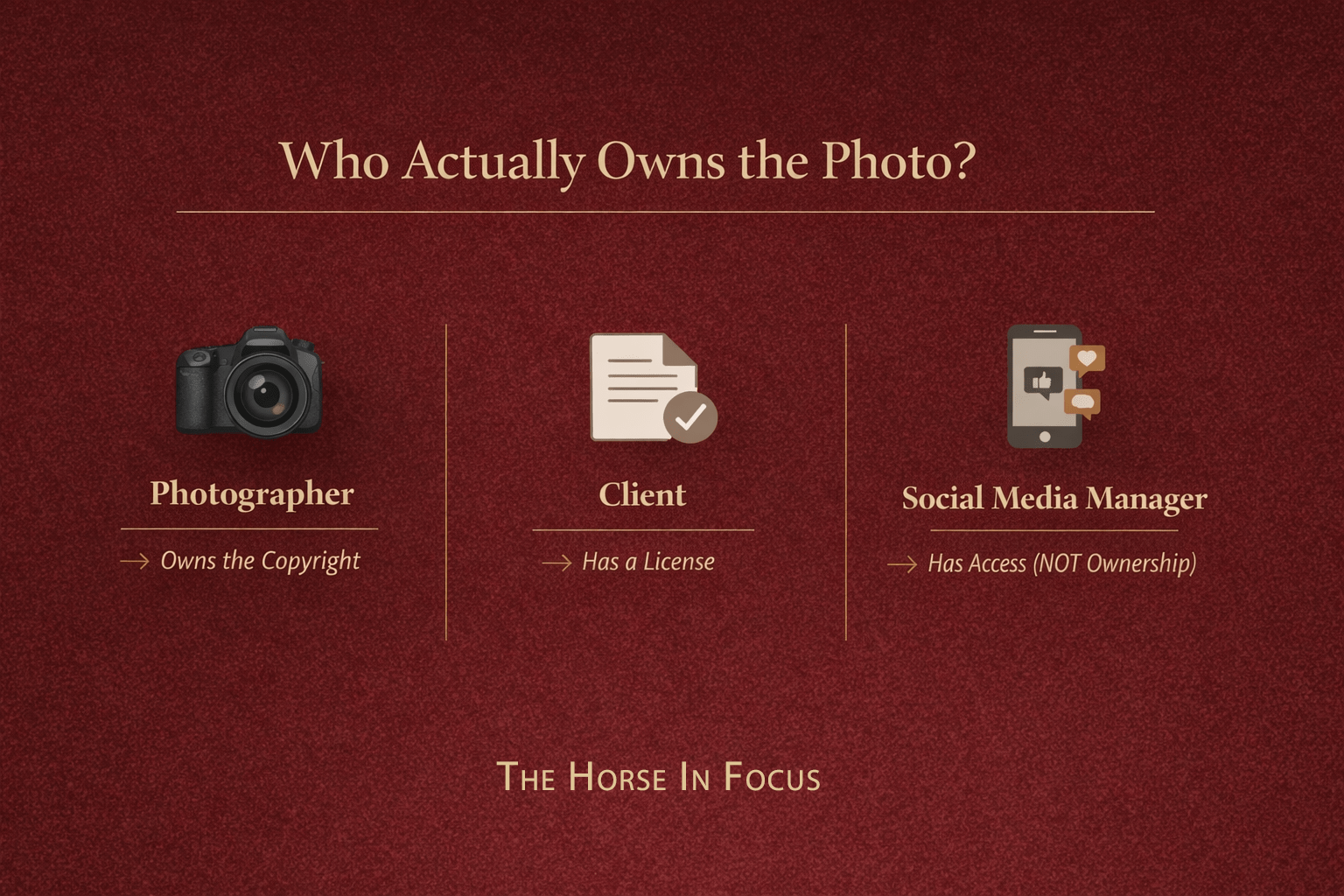
In almost every professional scenario, the photographer owns the copyright to the image.
Not the client.
Not the brand.
Not the social media manager.
What the client receives is a license — permission to use the image under specific terms.
Those terms are rarely unlimited.
And they almost never include:
“Any third-party vendor can use these images to promote their own business.”
Where Social Media Management Is Getting Misunderstood
Right now, social media management is being marketed — and perceived — as quick, easy income.
Post a few times a week.
Write some captions.
Schedule content.
Call yourself a social media manager.
And to be fair, there are people doing this well — professionally, strategically, and with a real understanding of marketing.
But there is also a large wave of new entrants who are stepping into this space without understanding:
-
copyright
-
licensing
-
content ownership
-
or the difference between managing content and owning it
And that gap in understanding is where photographers — and sometimes even clients — get burned.
Managing Content vs. Owning Content
Whether you are a social media manager or a sale company, the distinction is the same.
There is a difference between:
Using content on behalf of a client or consignment
and
Using content to promote your own business
The first can fall within licensing, depending on how the images were delivered.
The second is a separate commercial use.
And that’s where permission matters.
The Portfolio and Promotion Problem
This is where it becomes very visible.
A social media manager builds a brand using client images.
A sale company builds advertising campaigns, highlight reels, and promotional posts using images sourced from consignors.
And in both cases, the images are often:
-
not owned by the person using them
-
not licensed for that specific use
-
and not cleared with the photographer
At that point, the image is no longer serving just the original subject.
It is serving the business that is reusing it.
“But We Gave Credit”
This comes up every time.
“We tagged the photographer.”
“We credited them in the caption.”
Credit does not equal permission.
It does not expand a license.
It does not replace a contract.
It does not make unauthorized use acceptable.
It simply acknowledges the creator while still using the work outside of its intended scope.
Why This Matters More Than People Think
It’s easy to dismiss this as a technicality.
It’s not.
Because what’s happening is this:
Businesses are being built and marketed using visual content.
That content has real, tangible value.
And the people creating that content rely on licensing to sustain their business.
When that content is reused outside of its license:
-
it removes control from the creator
-
it bypasses compensation for additional usage
-
and it quietly shifts value away from the person who created the work
This isn’t about being difficult.
It’s about maintaining a system where creative work is respected and properly used.
The “Easy Money” Problem
Part of why this is happening more frequently is because social media management — and even certain types of marketing services — are being positioned as quick, easy income.
Post consistently.
Stay active online.
Grow accounts.
Get clients.
And while there is absolutely a professional level to this work, there is also a large influx of people entering the space without understanding:
-
copyright
-
licensing
-
usage rights
-
or the legal boundaries around content
That lack of understanding doesn’t make the issue harmless.
It just makes it more common.
A Note to Social Media Managers and Sale Companies
If your business relies on images you did not create, this applies to you.
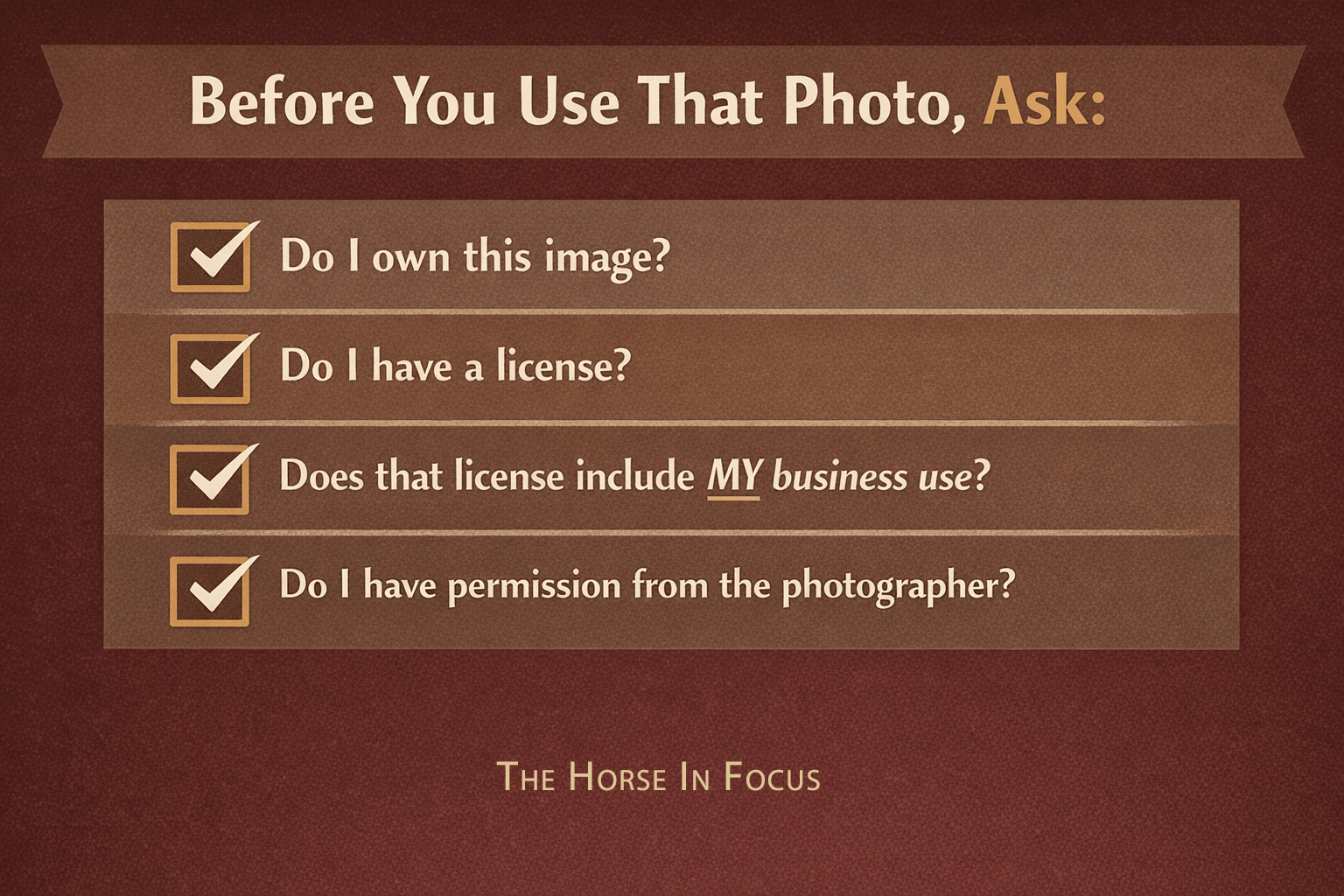
Before using any image to promote your business, ask:
Do I have permission from the photographer to use this for my company’s marketing?
If the answer is no — or unclear — then the answer is no.
There are professional ways to handle this:
-
request written permission
-
obtain proper licensing
-
work directly with photographers
-
or create content specifically for your business
Those steps take more effort.
But they are also what separate professional operations from assumptions.
A Note to Business Owners and Consignors
If you are providing images to a social media manager or a sale company:
Understand what rights you actually have.
Because in most cases:
You have the right to use those images for your business.
You do not automatically have the right to pass along expanded usage to others.
If those images are being used beyond that scope, it may not have been intentional…
But it is still outside the original agreement.
This Isn’t About Gatekeeping
This is about clarity.
The equine industry is growing.
There are more services, more businesses, and more opportunities than ever before.
But growth without understanding creates friction.
And right now, this is one of the areas where that friction is showing up.
Final Thought
If your business uses visual content — in any capacity —
Then understanding who owns that content and how it can be used is not optional.
It is foundational.
Because at the end of the day:
Just because a photo was handed to you…
does not mean it was handed to you with rights.
In a few days, I’ll break down exactly who has the right to use what — and where most people are getting it wrong.
Recent Comments