
Why Can’t Multiple Photographers Just Shoot the Same Horse Show?
It’s a question that comes up frequently in photography discussions:
“Why can’t multiple photographers just compete at horse shows?”
On the surface, the idea seems logical. In many industries, competition improves quality and gives customers more choices. If several photographers were working at the same event, wouldn’t that simply create more options for exhibitors?
In theory, perhaps.
In practice, horse show photography works very differently.
The issue isn’t competition — it’s coverage.
Horse Shows Require Complete Coverage
A typical horse show isn’t a single performance.
It’s a full schedule of classes that can run for 10 to 12 hours a day, sometimes across multiple arenas.
At many shows, that means photographing:
-
every class
-
every exhibitor
-
every awards presentation
-
every division championship
From the exhibitor’s perspective, there is an expectation that if they enter the ring, their ride will be photographed.
That expectation creates a very different business model than many other types of photography.
Instead of selecting only the most interesting moments, the photographer is responsible for documenting the entire event.
"Horse show photography isn’t about chasing the most exciting moments.
It’s about making sure every exhibitor who enters the arena is photographed."
One Photographer Doesn’t Mean One Camera
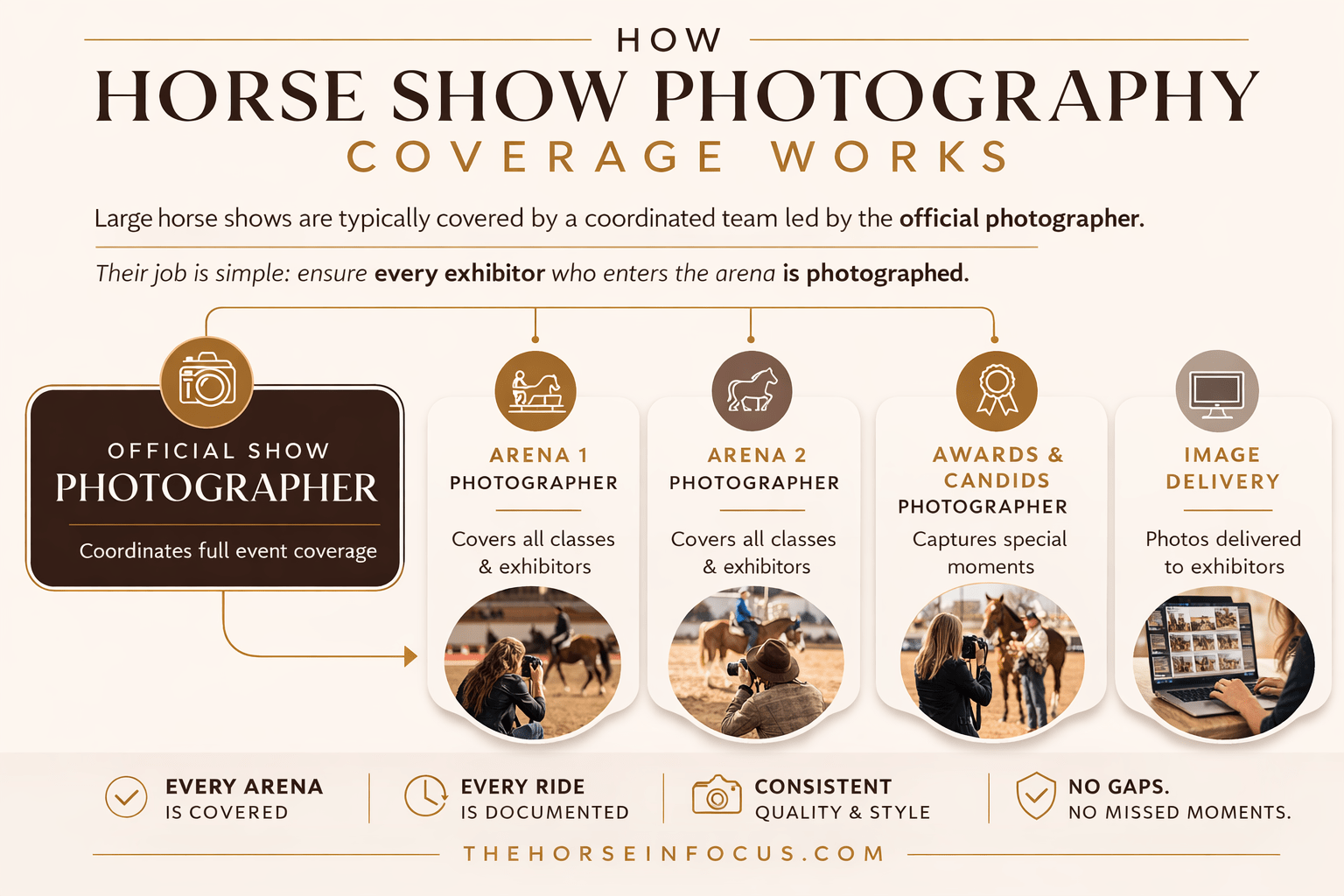
"One official photographer doesn’t mean one camera.
Most large shows rely on a coordinated team of photographers to ensure every arena and every ride is covered."
When a horse show hires an official photographer, that doesn’t mean a single person is responsible for capturing everything.
Large shows often require multiple photographers working as a coordinated team.
The official photographer frequently hires second shooters or additional staff photographers to make sure every arena and every class is properly covered.
For example, a show may have:
-
one photographer assigned to each arena
-
another photographer covering awards and candid moments
-
additional photographers rotating between busy divisions
This coordinated team approach ensures that every exhibitor receives coverage, even at large multi-arena events.
The difference is that those photographers are working together under one system, rather than competing independently.
How Horse Show Photography Coverage Works
What Happens When Photographers Work Independently
When several photographers attempt to cover the same event independently, coverage often becomes uneven.
Naturally, most photographers gravitate toward:
-
larger classes
-
top competitors
-
dramatic runs
-
popular divisions
Meanwhile, quieter parts of the schedule can end up with little or no coverage.
From an exhibitor’s perspective, that can create a frustrating experience.
Two riders in the same class may have completely different outcomes — one with dozens of images available and the other with none.
A coordinated photography team is responsible for ensuring that everyone who enters the ring is photographed, not just the most visually exciting moments.
The Economics of Event Coverage
Event photography also operates under a different financial structure than portrait or commercial photography.
Covering a horse show typically requires:
-
long shooting days
-
multiple days on site
-
expensive equipment
-
thousands of images to process and edit
-
large online galleries to manage
-
customer service for hundreds of exhibitors
Unlike portrait sessions, there is no guarantee that every exhibitor will purchase images.
The photographer invests significant time and resources before knowing what the final sales will be.
If multiple independent photographers were dividing those same sales, it would quickly become impossible to support the level of coverage exhibitors expect.
Consistency Matters to Exhibitors
Another factor exhibitors often appreciate is consistency.
When one photography team covers an entire event, exhibitors receive images that are:
-
photographed from consistent positions
-
edited in a consistent style
-
organized in predictable galleries
-
delivered through a single system
That consistency makes it easier for riders to find and purchase their images.
When several photographers are working independently, the experience can quickly become fragmented. Exhibitors may find themselves searching through multiple websites or galleries trying to locate images from a single run.
Competition Still Exists
None of this means competition doesn’t exist in horse show photography.
It absolutely does.
Shows evaluate photographers based on:
-
reliability
-
image quality
-
professionalism
-
exhibitor satisfaction
-
consistency of coverage
Photographers build reputations over years of work, and shows may change photographers if they believe someone else can provide a better experience.
But that competition happens between events and contracts, not inside the arena during the class.
Understanding the Real Job
From the outside, horse show photography can look like a creative opportunity.
And it is.
But it is also a logistical responsibility.
The job isn’t just to capture dramatic moments. It’s to document the entire competition in a way that serves the riders, owners, and the event itself.
That’s why most horse shows rely on a coordinated photography team led by an official photographer, rather than a group of independent photographers all trying to cover the same event.
The goal isn’t to limit competition.
The goal is to ensure that every exhibitor who enters the ring has the opportunity to see their ride captured and remembered.
If you’re new to the industry, you may also want to read our article on why simply showing up with a camera isn’t the path into horse show photography.
The Horse in Focus exists to elevate the conversation around equine photography — not just the creative side, but the professional standards that shape the future of the industry.
Continue the Conversation
THIF explores the professional, ethical, and business realities shaping equine photography today.
© The Horse In Focus
Trackbacks/Pingbacks